Monday, 29 June 2020

Thamnochortus insignis: The silent invader at UWC - Cape Flats Nature Reserve

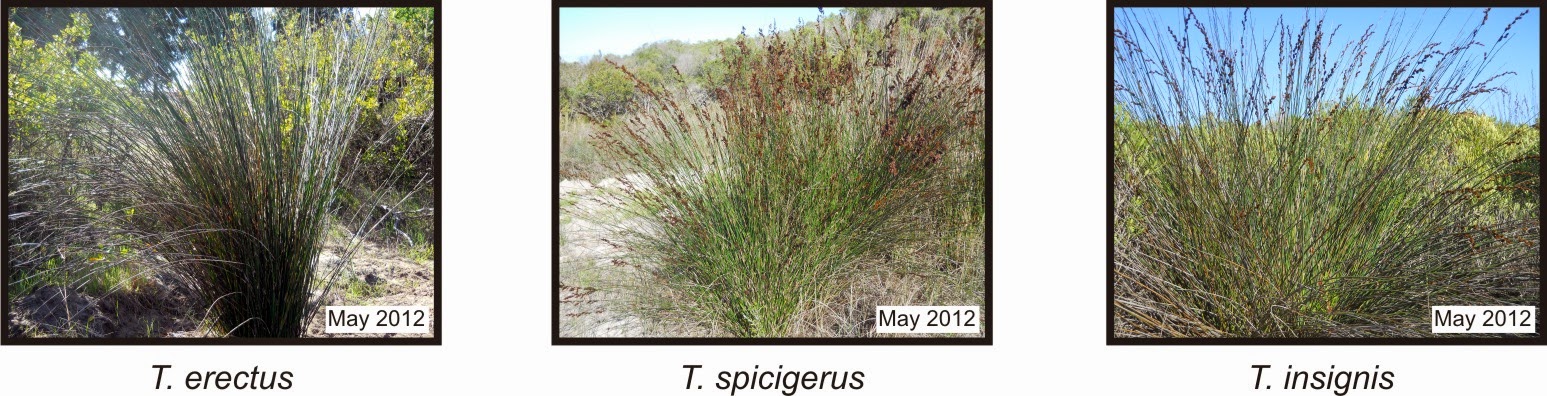
The family Restionaceae is characteristic of the pyrophytic Fynbos biome, in which Thamnochortus is one of the largest of 58 genera.  Two Thamnochortus species are endemic to the UWC - Cape Flats Nature Reserve.  Today a third species, T. insignis which is the preferred thatching reed of this genus is also present. Effective management requires fire remediation; therefore T. insignis cannot be ignored.

UWC - Cape Flats Nature Reserve
  • Established in the 1970's, proudly owned by University of the Western Cape
  • Today  a Private Nature Reserve and Provincial Heritage Site
  • Host to both Cape Flats Sand Fynbos and Cape Flats Dune Strandveld vegetation types
  • Five species of Restionaceae are endemic: Thamnochortus erectus, T. spicigerus, Chondropetalum microcarpum, Restio eleocharis and Willdenowia teres


Thatching Industry
  • A multi-million rand industry and  key source of income to small-scale farmers and local thatchers
  • High demand lead to an increase in cultivation and distribution of restios
  • High potential for mismanagement and incorrect thatching procedures
  • Thatching Association of SA - not enforced by legislation
  • T. insignis beyond its natural range due to:  transportation (Haaksma 2000) and improper protocol (Campbell 2006)

Materials and Methods
  • Field work (conducted May 2012 on female plants)
  • Plant identification: Flowering Plants of the Cape Flats Nature Reserve (Low 1983), DELTA
  • Key - Description Language for Taxonomy  (Linder 2006)  and site visit in May 2012 by CREW -Custodians of Rare and Endangered Wildflowers  (Tygerberg)
  • Rhizome comparison - three Thamnochortus species
  • GPS co-ordinates (structures and female T. insignis)
  • Inspection of thatch structures - spikelets present in thatch

Lab Identification
  • Flower morphology - Cape Plants (Goldblatt and Manning 2000) and Restios of the Fynbos Haaksma 2000)

Results

Flowers - comparative identification


Initial field identification was carried out based upon female spikelet length (Goldblatt and Manning 2000).  This identification was further supported by flower morphology (Haaksma 2000) at the laboratory (Table 1).

Table 1 - Contrast amongst species

Rhizomes - comparative identification

Discussion
  • Cape Flats Nature Reserve is vulnerable to invasion due to its small size and isolation through urbanization
  • Indigenous species are often more successful “invaders” than non-indigenous species in areas of high endemism
  • Within pyrophytic environments most plants are either  re-sprouters or re-seeders
  • T. erectus is classed as a sister group to T. insignis (Verdu et al. 2007)
  • T. insignis (re-seeders) – T. erectus and T. spicigerus (re-sprouters)
  • Re-seeders generate only from seed-bank post fire, whilst re-sprouters generate from both rhizomes and seed-bank
  • Re-seeders have a shorter life span than re-sprouters, hence they are able to build a greater seed-bank than re-sprouters
  • T. insignis is a pioneer species and favours disturbance, whilst T. erectus is considered as a component of a climax community within a pyrophytic environment

Fire as a management tool
  • Prevents competitive exclusion within the community and thus promotes biodiversity within
  • Increases available nutrients and the reduction of granivory and herbivory
  • Considered as a vector for the establishment and spread of invasive species.
  • Necessary in preserving biodiversity over a long period of time and is an important factor which has driven divergence with Fynbos

“Thamnochortus insignis plants also have a competitive advantage, because they have an extremely large reproductive output and persistent soil-stored seed bank.  A planned late summer or autumn burn would ensure maximum regeneration of fynbos species, including T. insignis and ensure conservation of species biodiversity.  Burning outside the late summer to autumn period would result in the local extinction of the majority of fynbos species although T. insignis with its persistent seed bank would show good regeneration provided that sufficient time has been allowed for soil seed bank accumulation.  Prescribed burning in this season is not recommended if species conservation is an objective, although it could be used as a management tool to control shrub densities.  Thatch plants can be harvested on a rotation when biomass levels have increased sufficiently.  Prescribed burning could also be risked after harvesting T. insignis plants, provided that sufficient time has been allowed for seed bank accumulation.”  JM Ball (1995) pg. 286


Main References

BALL, J.M., 1995. Comparative seed and regeneration biology of two thatching reed species
(T. insignis and T. erectus, Restionaceae).  Unpublished master’s thesis, University of Cape Town, Cape Town.

CAMPBELL, T.A., 2006.  The effects of fire and harvesting on Restionaceae spp.
(Thamnochortus insignis and T. erectus) with different life histories:  A matrix modelling approach. 
Unpublished master’s thesis of science,  University of Stellenbosch.

VERDU, M. PAUSAS, J.G., SEGARRA-MORAGUES, J.G., OJEDA, F., 2007.
Burning phylogenies:  Fire, molecular evolution rates and diversification.
The society for the study of evolution:  Evolution 2195-2204.


Alexis Osborne, Lyle Lucas, Nicole Bauer-Schmidt (Interns 2012), Hestelle Melville (Supervisor), Laurenda van Breda (Photographer/Editor)


Euphorbia marlothiana: The theory continues...

Since my last post on this topic in February 2013, I have felt strongly about testing my theory on whether we should let nature take its course or to "cover and protect" the species. 

What lead me to this theory was my observation on the growth form of the Euphorbia marlothiana.  All images of this species, whether it was in an ID guide or on google, showed the same growth form: short and the stand size widely spread in diameter.  The Cape Flats Nature Reserve has eight populations of E. marlothiana and the stands that were covered, looked very different in comparison to the normal growth form.  These stands were small in diameter but the individual “fingers” were extremely long and scraggly.  They were growing in length but not in stand size.  This observation lead to a worrying thought that if this abnormal growth continued, the population size might eventually decrease.  

                                                                            Image showing normal growth form

                                                                        Image showing abnormal growth form

Subsequently I’ve been doing some experimenting, not official research as such, but who knows where this information could lead in future as it is currently data deficient according to the Red List of South African Plants, 2009.
The experiment involved removing the covers and letting the grysbok, tortoise and whichever other animal, browse the tips to keep them short, and in turn strengthens the individual stands.  These stands were monitored over the past year and a half for any changes in growth form.  The visual results were pleasing to say the least.   The old scraggly “fingers” are still there but the new growth has been allowed to be browsed and it shows a healthier, normal looking growth form.  Measurements of the “finger” lengths have been noted and the browsing remains at a certain height, further indicating that over-browsing has not posed a problem thus far.

                                                            Image showing wire mesh covers over E. marlothiana

                                                               Image showing signs of browsing

                                                                                        Image showing new growth

I hope you have found this post interesting and for those who would like to know more, I will keep you updated on any new and interesting observations I've made regarding this species.

Euphorbia marlothiana

As conservators we have the good intention of saving our species from extinction...but are our actions speeding up the process? 

Euphorbia marlothiana, commonly known as Medusa's Head, gets its name from its multi-branched appearance.  This particular species is regarded as vulnerable and only occurs in the Strandveld region in Cape Town, South Africa.  It only occurs within three reserves on the Cape Flats, namely the Cape Flats Nature Reserve, Macassar Dunes and Wolfgat Nature Reserve.

With so few populations left in the world, we desperately want to protect them.  Very little research has been done on this species thus far.  At the Cape Flats Nature Reserve this species has been covered by fencing to prevent the Grysbok eating them so that the population can grow. Is it not sometimes best to let nature take its own cause?  Do they not need to be disturbed and browsed to strengthen and produce a stronger, healthier plant?


Thursday, 25 June 2020

Ruschia macowanii

Scientific name: Ruschia macowanii (L. Bolus) Schwanites
Family: AIZOACEAE
Common name: magenta purple vygie/ Pers vygiebos

Plant Description  
Every coastal garden deserves to have this round succulent bush covered in purple-pink flowers. Ruschia macowanii is a spreading shrub up to 20 cm tall and 50 cm across or more. It does not root at the nodes. It has hard, fleshy dull green leaves and a cluster of purple-pink flowers that appear from August to October. The fruit has five chambers that once they are ripe will open when they become wet.


The genus Ruschia was named in honour of a Namibian farmer by the name Ernst Julius Rusch (1867 – 1957).

Growing and maintenance of Ruschia macowanii
It requires well-drained soil, full sun and very little watering. It thrives in most soil types but too much water will cause root rot. It is ideal for rockery, mixed beds, embankments as well as containers. It is water-wise and suitable for coastal gardens.
Ruschia macowanii can be propagated from seed or by means of cuttings. Heel cuttings can be taken from spring to autumn. To encourage rooting cuttings can be dipped into rooting hormone powder and plant them into river sand. Cuttings can also be placed in a cool spot and kept moist. 
The UWC Cape Flats Indigenous Nursery grows Ruschia macowanii.

References
Manning, J. 2007, Field Guide to Fynbos, Random House Struik (Pty) Ltd, Cape Town
Riddles, R. 2012, PlantZAfrica. http://pza.sanbi.org/ruschia-maxima. Accessed 15/05/2020


Monday, 22 June 2020

Dealing with soil

Soil is the life support system for plants. It provides anchorage for roots, holds water and nutrients. Determining the type of soil in your garden is the key to successful gardening. This plays a critical role in your choice of plants without having to modify your soil composition. Scanning plants in your area will also give you an indication of the type of plants that will thrive. Visit your nearest nature reserve, garden centre or nursery to get a list of plants that occur naturally in your area as these use our natural resources optimally. A soil type will have three primary elements namely, sand, loam and clay soil. So your soil will be a combination of these three elements of soil in different quantities and hummus that provide plants with nutrients.

Monday, 8 June 2020

Propagating Phyllobolus canaliculatus (Vingerkanna)

Phyllobolus canaliculatus cuttings

In our outreach programme, we work with schools and community members to help instil the love of plants and the protection of nature. Come join us when we teach children how to propagate 
Phyllobolus canaliculatus.  


Monday, 1 June 2020

Phyllobolus canaliculatus

Phyllobolus canaliculatus 
Family: AIZOACEAE 
Common name: Vingerkanna

Plant Description  
Phyllobolus canaliculatus is a branched perennial succulent with a fleshy rootstock and soft branches. A geophyte with tuberous roots and softwood branches that root at the end of nodes. The leaves are opposite below but alternate in the inflorescence and with prominent bladder cells. It bears glistening white flowers that are 20 – 30 mm in diameter. 

The name Phyllobolus is taken from the Greek word phyllon meaning leaf; bolos meaning throwing; referring to the deciduous shedding of leaves by some species. The specific epithet canaliculatus means with a longitudinal groove or channel, long and concave; referring to the leaves of the species. Most species of Phyllobolus have conspicuous water cells much like Mesembryanthemum. They are winter-growing caudiciforms and are deciduous, even shedding stems, in summer.


Growing and maintenance of Phyllobolus canaliculatus
Phyllobolus canaliculatus is suitable for winter rainfall gardens. It is ideal for coastal and water-wise gardens. It grows in well-drained soil and sun. Propagate Vingerkanna through cuttings, rooted runners and seeds. They can be planted directly into the soil and early autumn will be an ideal time to plant rooted runners and seeds. This plant available at UWC Nature Reserve Unit Nursery.

References
https://www.plantnames.co.za/species.php?genus=381
https://www.fernkloof.org.za/index.php/all-plants/plant-families/item/phyllobolus-canaliculatus
Kersting, D. (compiler) 2001. Wildflowers of the Cape Peninsula. Botanical names: Origin and meaning. Flora Documentation Project, Friends of the Silvermine Nature Area, St James.

Fiona Powrie,1998. Kirstenbosch Gardening Series, Grow South African Plants. Cape Town.